




History [ edit ]
Between the years and , farmers migrated from the Transvaal to what was then southern Angola. There, they came into conflict with the Portuguese colonial authorities, and some of their number decided to return to the Transvaal, while others migrated further south.[1]
In , William Worthington Jordan bought a tract (fifty thousand square kilometers) of land from the Ovambo chief Kambonde for three hundred pounds, paid as twenty-five firearms, one salted horse, and a cask of brandy.[2] This land stretched almost 170 kilometres (110 mi) from Okaukuejo in the west to Fischer's Pan in the east.[3] Chief Kambonde relied on the help of Jordan to defeat his rival for power, Nehale.
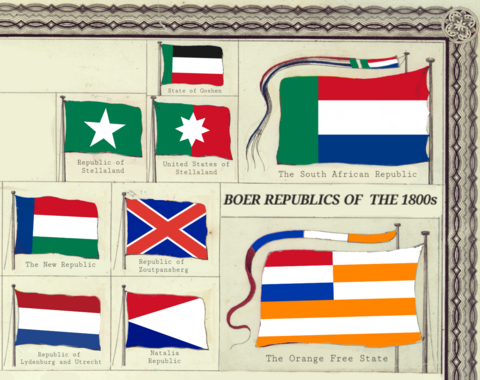
Between and , at the time of the Dorsland Trek, Boers had crossed the area, heading for Angola. In some of these trekkers returned and settled at Grootfontein on land given to them free of charge by Jordan. The Republic of Upingtonia was declared on .[1] At that time, the population of Upingtonia was around five hundred settlers. The state was named after Thomas Upington, prime minister of the Cape Colony, from whom the new state was hoping for support. However, little was forthcoming. [4] In , under the influence of the Boers returning to the Transvaal from southern Angola, the name was changed from Upingtonia to Lijdensrust or Lydensrust.
The short-lived republic's capital was Grootfontein, and its head of state was President George Diederik P. Prinsloo. The new state fought the Herero and became dependent on German protection. In Jordan was killed by Nehale Mpingana, and the republic collapsed. The next year the area it had covered was incorporated into German South-West Africa.[5]
Notes [ edit ]
- ^ a b Chris Marais, Julienne Du Toit, A Drink of Dry Land (2006), p. 174
- ^ Ute Dieckmann, Haillom in the Etosha Region: A History of Colonial Settlement, Ethnicity and Nature Conservation. (Basler Afrika Bibliographien, 2007), p. 48
- ^ G. P. J. Trümpelmann, Die Boer in Suid-wes Afrika (1948)
- ^ Robbie John MacVicar Aitken, Exclusion and Inclusion: Gradations of Whiteness and Socio-Economic Engineering in German Southwest Africa, 1884-1914 (2007), p. 191
- ^ Victor L. Tonchi, William A. Lindeke, John J. Grotpeter, Historical Dictionary of Namibia (2012), p. 445
.svg.png)
.svg (1).png) Founding of
Founding of  Merged into

